
Related Blogs
- Finance Ops Transformation in GBS - Balancing Technology, Talent, and Data-Driven Insights for Peak Performance
- Unlocking the Future of Procurement: Balancing Cost, Automation, and Strategic Relationships for Maximum Value
- Overcoming AI Adoption Barriers in the Gcc Gbs Ecosystem Pathways for Progress
- Driving the Gen AI Revolution
- THE ESG CONUNDRUM: Why High Costs and Data Complexities are Stalling Progress and How Capability Centers can Turn the Tide
- BUSINESS AS USUAL IS OVER: Sustainability Disruptions will Redefine the Future of Business
Contact Us
-
Call Us:
+91-11-26674814
-
Mail Us
contact@quintesglobal.com
Improving Customer Experience: What Leaders Say Works Best
Introduction: The Evolution to AI-First Global Capability Centers
-
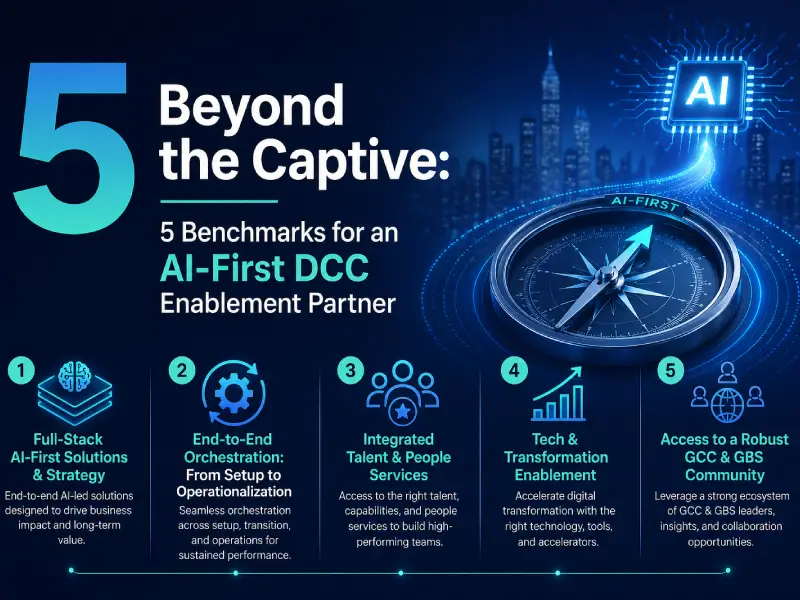
Full-Stack AI-First Solutions & Strategy
A modern GCC enablement partner must view every business process through an AI lens. It is no longer enough to “digitize” legacy workflows; you must build an AI-First blueprint from day one.
Look for a partner that provides a comprehensive GCC Strategy & Blueprint that covers:
- Target Operating Model (TOM) Design: Aligning GCC functions with global enterprise goals.
- AI-Native Workflows: Integrating Generative AI and automation into core enterprise functions (Finance, HR, Supply Chain).
- Scalable Roadmaps: Moving from pilot projects to enterprise-wide AI adoption.
-
End-to-End Orchestration: From Setup to Operationalization
Fragmented partnerships lead to fragmented results. Your partner should offer a seamless transition across the entire GCC lifecycle.
This “Full-Stack” approach ensures a single point of accountability for:
- End-to-End GCC Setup: Entity incorporation, legal frameworks, and regulatory compliance.
- Transition & Operationalization: Migrating processes using proven playbooks without disruption.
- Enabling Services: Managing real estate, IT infrastructure, and facilities so you focus on core business.
-
Integrated Talent & People Services
In an AI-first world, the talent war is about capability density, not just headcount.
Under the Dedicated Collaboration & Capability (DCC) model:
- Curation of Niche Skills: Hiring experts in AI, Data Science, and specialized domains.
- Cultural Integration: Aligning teams with the parent company’s DNA.
- Continuous Upskilling: Keeping teams ahead of evolving technologies.
-
Tech & Transformation Enablement
A GCC is only as strong as its technology backbone. Your partner should drive innovation, not just delivery.
- Cloud & Platform Engineering: Building secure and scalable systems.
- Hyper-automation: Reducing manual work through automation.
- Data Democratization: Turning data into actionable insights.
-
Access to a Robust GCC & GBS Community
Knowledge grows through collaboration. A strong ecosystem enables continuous improvement and innovation.
- Peer-to-Peer Learning: Sharing real-world insights.
- Playbook Sharing: Standard governance and compliance practices.
- Industry Trends: Staying ahead of GCC evolution.
Redefining the Model: Why DCC?
Traditional “Captive” models often suffer from high overhead and slow agility. The DCC (Dedicated Collaboration & Capability) model is designed to solve this. It provides the control of a captive center with the agility and expertise of a specialized service provider.
By partnering with Quintes Global, you aren’t just setting up an office; you are building a Full-stack AI-First Capability Engine. Is your GCC ready for the AI-First era? Explore our GCC & GBS Transformation Solutions at Quintes Global
The shift from a traditional GCC to an AI-First DCC requires a fundamental change in how you view “value.” Are you currently looking to optimize your existing enterprise functions, or are you starting with a blank canvas for a new global center?